Riverside Village


Introduction
Hello everyone, my name is Dinesh Sirvi, and I’m an Environment Artist from Rajasthan, India.
I’ve been working in the game industry for around 4 years. My career started as a Junior 3D Artist in 2021, where I had the chance to learn and contribute across different team disciplines involved in asset creation.
During this period, I worked on multiple projects and pipelines, taking responsibility for maintaining the quality of highly detailed assets while ensuring accurate scale and proportions.
At present, I’m working at Sperasoft, a Keywords Studio in Abu Dhabi, as a 3D Artist.
Project
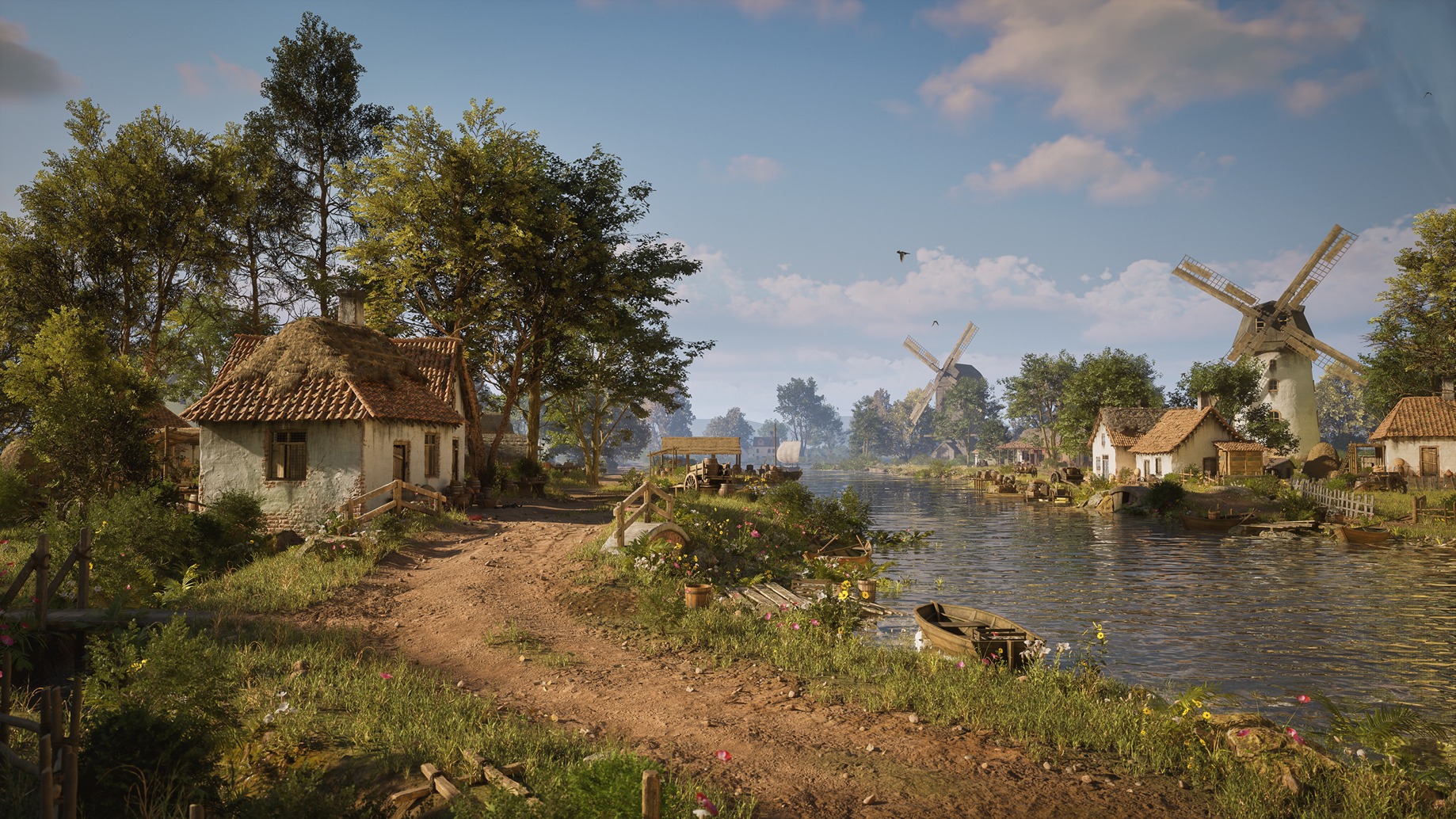
This project was created in Unreal Engine 5 and marked both a personal challenge and a creative journey for me.
My goal was to design a complete environment from the ground up while evoking a strong sense of atmosphere, life, and narrative within the scene.


Concept
The inspiration came from a beautiful painting by Lodewijk Johannes Kleijn, whose work immediately captivated me with its mood and storytelling.
I aimed to reinterpret that essence in 3D, finding a balance between realism and painterly qualities.

To achieve this, I began by gathering real-life references along with old painting concepts to guide the mood and design of the scene.
Using these references, I created a blockout of the house and then imported it into Unreal Engine.
From there, I focused on shaping the landscape, paying special attention to the path to make it feel more natural and immersive.

Additionally, since I wanted the environment to feel like a playable level in gameplay.
I also planned out extensions of the path to connect to other areas.

Making of Big Structures
I modeled the large structures and applied simple vertex colors mainly for visibility during the early stage.
Once the size and shape were finalized in the engine, I added more details later.
Big structures are very important because they define the placement and overall order of the environment.


Landscape Painting & Sculpting
For landscape painting in Unreal Engine, I first focused on finalizing the main path of the environment, as the entire village is built alongside it.
After setting the main road, I planned smaller paths branching off to add more detail and a natural flow to the scene.


I also defined the height and shapes of the terrain using the Landscape Sculpt tool, which helped me create a more believable foundation for the environment.


River
For the river, I used Unreal Engine’s default Water Body River plugin, which helped me quickly set up the flow and shape of the water to fit naturally into the scene.

Adding Foliage & Trees
To match my reference, I started by placing Megascans trees, focusing first on achieving a look that closely aligns with real-life references.
I began by manually placing the trees according to my reference, ensuring the scene felt natural and consistent with the original inspiration.


Landscape, Foliage & Decals
After shaping the main terrain, I refined the landscape to enhance the natural flow of the environment.
I added grass to bring life and variation to the ground, making the terrain feel more organic.


On the village structures, I applied decals to add wear, dirt, and small details, which helped integrate the buildings more naturally into the scene.
These subtle touches enhance realism and make the environment feel lived-in and believable.


Lighting, Mood, & Final Details
Once the landscape was fully shaped, I focused on refining the lighting and overall mood of the scene to create the atmosphere I envisioned.
I finalized all landscape details, including grass and water textures, ensuring they blended naturally with the environment. To enhance realism, I added small details such as props, scattered foliage, and other elements that bring life to the scene.
These finishing touches helped make the environment feel cohesive, immersive, and visually engaging.


Rendering
After completing the environment, I moved on to rendering the scene to showcase its full potential.
I carefully adjusted the lighting setup, including directional lights, skylight, and atmospheric settings, to enhance the mood and highlight key areas of the landscape.


I fine-tuned post-processing effects such as color grading, bloom and ambient occlusion to achieve a cinematic and polished look.
For the final renders, I set up multiple camera angles to capture the environment from different perspectives, emphasizing the scale,
depth and details of the scene.
The combination of well-planned lighting, textures, and props ensured that the rendered images faithfully represented the atmosphere and storytelling I aimed to achieve.
Conclusion
For aspiring Environment Artists, my advice is to stay consistent and dedicate time to proper planning before beginning any project.
A well-structured plan not only saves time but also ensures a smoother creative process.
It’s equally important to discuss your work with friends and colleagues and always remain open to feedback, since constructive feedback plays a key role in refining your artwork and making it truly shine.
In closing, I’d like to extend my gratitude to my close friend Vivek Thakur for his valuable feedback and support, which greatly contributed to the final outcome of this project.
Read more articles
You might also like these articles.